Dean of the Faculty of Law at the Constitutional Court: New Criminal Procedure Code Seen as Blurring the Line Between Advocates and Non-Advocates
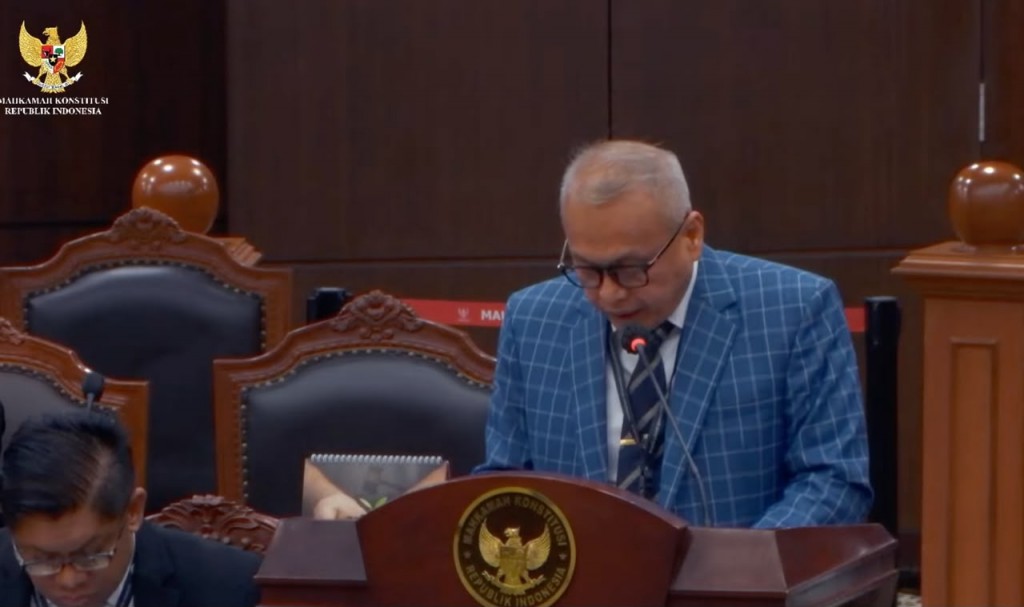
The Dean of the Faculty of Law at Unissula Semarang, Prof Dr Jawade Hafidz SH MH, considers that a number of provisions in Law No. 20 of 2025 on the Criminal Procedure Code (KUHAP) may give rise to legal uncertainty because they blur the boundary of authority between advocates and non-advocates. Jawade presented this view while giving expert testimony at a hearing of the Constitutional Court on Wednesday (22/7/2026).
He appeared as an expert in Administrative Law in Case No. 104/PUU-XXIV/2026 concerning the review of Article 1 point 22 and Article 151 paragraph (2) letter b of the Criminal Procedure Code against the 1945 Constitution of the Republic of Indonesia.
According to Jawade, the main issue lies in the wording of Article 1 point 22 of the Code, which broadens the definition of an advocate to include anyone who may provide legal services, whether inside or outside the courtroom, as part of community service in offering free legal aid.
He considers that this wording leaves open the question of who exactly is meant by a party able to provide legal services. That lack of clarity about the legal subject may give rise to varying interpretations in practice.
From the perspective of Administrative Law, Jawade said, the status and authority of an advocate do not arise on their own. That authority is conferred under Law No. 18 of 2003 on Advocates and is obtained through specific stages and requirements.
A person who wishes to practise as an advocate must meet educational requirements, complete the Special Education for the Advocate Profession (PKPA), pass the professional examination, undergo an apprenticeship period, and take an oath in an open session of the High Court.
These stages, according to Jawade, are not merely administrative procedures but part of a mechanism to ensure the competence and professional accountability of those who provide legal defence to the public.
"Advocates exist as a counterweight to state power so that the judiciary does not turn into an instrument of arbitrariness," Jawade said in his expert testimony.
He explained that professional standards are needed to protect those seeking justice. Errors in legal assistance — from framing arguments and using legal remedies to meeting deadlines — can directly affect a person's rights in judicial proceedings.
For that reason, in his view, the provision of legal aid must still observe the principles of professionalism, competence, accountability, and equality of arms — the balance of position between the parties in judicial proceedings.
On the Record of the Oath
Jawade also drew attention to Article 151 paragraph (2) letter b of the Code. That provision governs the documents that must be shown when providing legal services or legal aid, namely the record of the oath of appointment as an advocate and/or proof of membership of a legal aid institution.
In his view, that phrasing may place the advocate's Record of Oath (BAS) on the same footing as membership identification in a Legal Aid Institution (LBH), even though the two have different legal bases and characteristics.
From the perspective of Administrative Law, Jawade sees the Record of Oath issued after the swearing-in at the High Court as formal legitimation of a person's status as an advocate and, at the same time, the basis of their authority to practise the profession.
Membership identification in a legal aid institution, by contrast, is legitimation that derives from an organisation. The two therefore cannot simply be equated in determining a person's authority to appear before a court.
"This equation is not merely a matter of drafting; it concerns the limits of authority and the accountability of those providing legal services," Jawade said.
He recalled that advocates, as a law enforcement profession, have a code of ethics and mechanisms of accountability through their organisation and honorary council. In his view, clarity about accountability mechanisms is also needed for non-advocates who are given room to provide legal assistance.
Jawade also referred to Supreme Court Decision No. 22 P/HUM/2018 concerning the authority of paralegals in judicial proceedings. That decision, in his view, is an important consideration in examining the limits of the authority of advocates and non-advocates in court.
Potentially Undermining Legal Certainty
In his testimony, Jawade concluded that the wording of Article 1 point 22 of the Code does not satisfy the principles of clarity of formulation and carefulness, and may create disharmony with the Advocates Law.
He also considers that equating the advocate's Record of Oath with a legal aid institution membership card under Article 151 paragraph (2) letter b may blur the difference between authority derived from the state and legitimation internal to an organisation.
Ultimately, according to Jawade, the issue concerns more than the interests of the advocate profession. More fundamental is the guarantee that the public can obtain legal aid and defence that is professional, competent and accountable.
In his view, the state does indeed need to widen public access to legal aid, especially for those who cannot afford it. But that widening of access must go hand in hand with guarantees of the quality of legal services and certainty about who has the authority to conduct a defence in court.
Jawade asked the Constitutional Court to weigh these provisions in the light of the principles of the rule of law, equality before the law, fair legal certainty, and protection of the rights of members of the public seeking justice.
Source: Unissula.ac.id