Faculty of Law Holds Public Discussion on the New Penal Code and Criminal Procedure Code with the Deputy Minister of Law
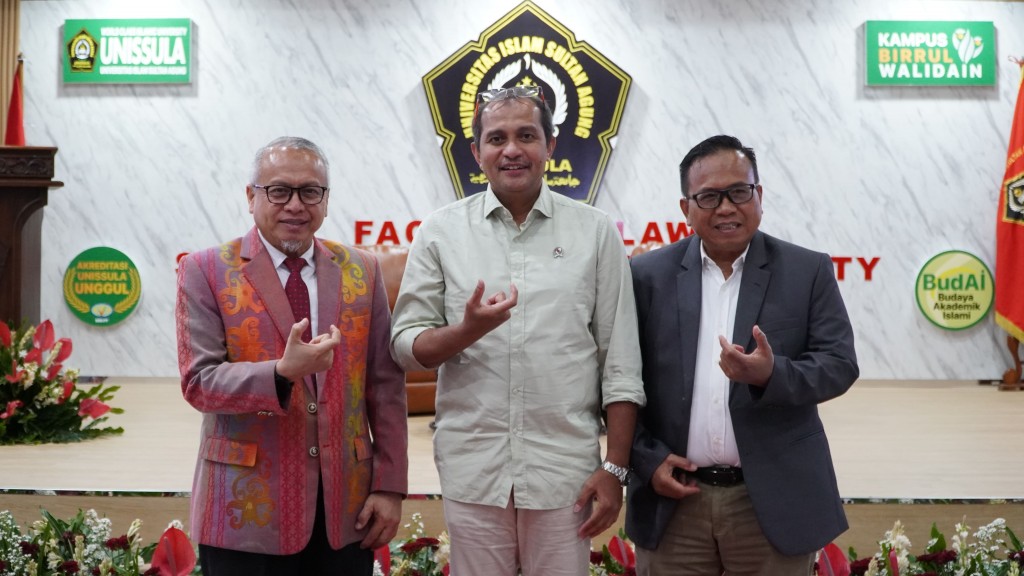
The Faculty of Law at Universitas Islam Sultan Agung (Unissula) held an event on the entry into force of Law No. 1 of 2023 on the Penal Code (KUHP) and Law No. 20 of 2025 on the Criminal Procedure Code (KUHAP) on Friday, 23 January 2026.
The event featured the Deputy Minister of Law of the Republic of Indonesia, Prof Dr Edward Umar Sharif Hiariej SH MHum, as the keynote speaker.
In his presentation, the Deputy Minister stressed that the entry into force of the new Penal Code and Criminal Procedure Code is an important milestone in national criminal law reform, one that demands readiness from law enforcement officers, academics and the wider public.
He emphasised that the entry into force of Law No. 1 of 2023 on the Penal Code cannot be understood in isolation; it must be read together with Law No. 1 of 2026 on the Adjustment of Criminal Penalties and Law No. 20 of 2025 on the Criminal Procedure Code.
"So if you read Law No. 1 of 2023 on the Penal Code, it must be compared and read alongside Law No. 1 of 2026 on the adjustment of penalties. They form a single body of substantive law," he said.
Procedural law — the manner of enforcement — is governed by Law No. 20 of 2025 on the Criminal Procedure Code, which guides law enforcement officers in operating the national criminal justice system.
While acknowledging that it is not easy to grasp every article in a short time, the Deputy Minister urged the public, academics and law enforcement officers to pay particular attention to Book One, especially Chapters I to IV, as these form the main basis for applying all the criminal provisions.
He further stressed that the vision of the national Penal Code is oriented towards corrective, restorative and rehabilitative justice and social reintegration. Under the concept of corrective justice, judges are given room to impose a penalty, a measure, or a combination of the two — a double track system — according to the needs of sentencing.
The new Penal Code also emphasises restorative justice, that is, the recovery of victims, as well as rehabilitative justice aimed at reforming offenders so that they can return to society. The principle of social reintegration is further reinforced by encouraging lighter and more proportionate penalties, including the abolition of short-term imprisonment and the strengthening of alternatives such as community service and supervision.
With the entry into force of the national Penal Code and Criminal Procedure Code, the government hopes Indonesia's criminal justice system will become more humane, modern and just, in keeping with the values of Pancasila and the development of society.
The Strategic Role of Universities
The event was officially opened by the Rector of Unissula, Prof Dr Gunarto SH MH, accompanied by the Dean of the Faculty of Law, Prof Dr Jawade Hafidz SH MH.
In his address, the Rector said universities have a strategic role in guiding the implementation of the new laws through academic study, legal education and community service.
The law sets out the types of criminal offences and criminal liability; the aims and principles of sentencing in a more modern, humane and just form; penalties and measures, including alternative penalties and recovery-based penalties (restorative justice); the protection of human rights; the values of Pancasila; and local wisdom.
The new law emphasises a balance between justice, legal certainty and usefulness, and gives priority to sentencing that is not merely retributive.
It aims to renew the criminal procedure system so that investigation, inquiry, prosecution and trial are more transparent and accountable.
It also strengthens protection of the rights of suspects, defendants and victims; strengthens the role of judges in supervising criminal proceedings; provides more adaptive rules on evidence and proof; and applies the principles of due process of law and restorative justice. The new Criminal Procedure Code is designed to keep pace with developments in law and technology and with the demands of human rights protection in a modern criminal justice system.
The Dean of the Faculty of Law added that this event forms part of the faculty's commitment to ensuring that its academic community and legal practitioners comprehensively understand the substance and implications of applying the new Penal Code and Criminal Procedure Code, in terms of law enforcement, human rights protection and legal certainty alike.
He also stated the faculty's full readiness to adapt its legal education curriculum in line with the entry into force of Law No. 1 of 2023 on the Penal Code and Law No. 20 of 2025 on the Criminal Procedure Code.
The event was attended by students, lecturers, legal practitioners and observers of the law, who followed the presentation and interactive discussion with enthusiasm. Through this forum, the Faculty of Law hopes to become an academic point of reference supporting the transition to and implementation of the new Penal Code and Criminal Procedure Code in a just and professional manner, in harmony with national values.
Source: Unissula.ac.id